After Builders Cleaning: What It Involves and What to Ask
Published 29 October 2026 · 5 min read
Short answer
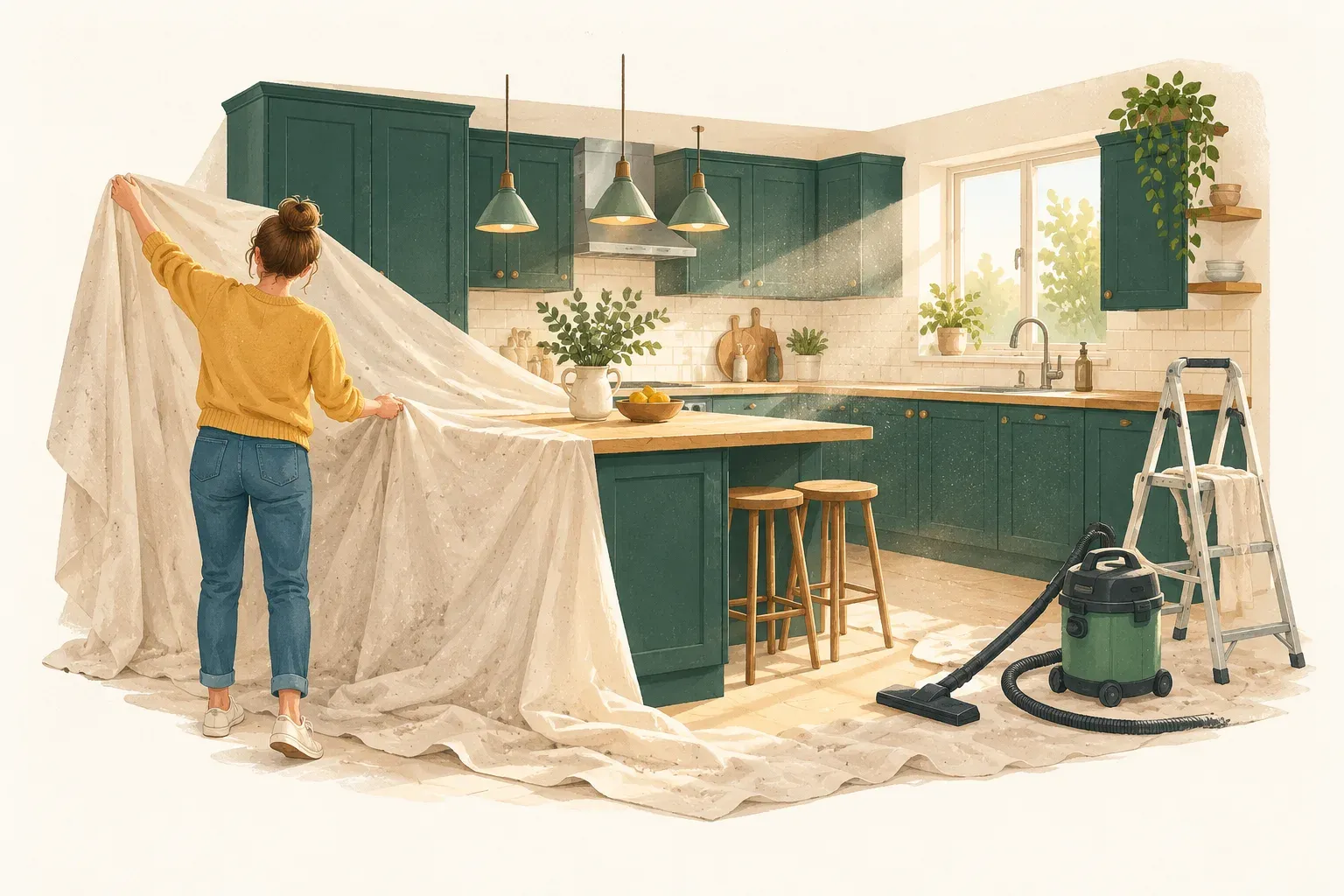
An after builders clean removes the fine plaster and sanding dust, paint spots, sticker residue and grime that a renovation leaves on every surface. It takes more than one pass, needs care with new finishes, and is best booked once the trades have fully finished.
An after builders clean removes what a renovation leaves behind: fine plaster and sanding dust on every surface, paint spots on glass, sticker and adhesive residue, grout haze, and grime in presses, tracks and light fittings. It is slower than an ordinary clean because fine dust gets everywhere and keeps settling, and because new surfaces scratch easily if the wrong product or pad is used.
Book it once every trade has finished, not while the painter or floor fitter still has a day to go.
How is it different from a deep clean?
A deep clean deals with everyday build-up in a lived-in home. An after builders clean deals with construction residue, often in an empty or half-furnished house. The differences that matter:
| Deep clean | After builders clean | |
|---|---|---|
| Main problem | Grease, limescale, everyday dust | Fine plaster and sanding dust, paint, adhesive, grout haze |
| Surfaces | Worn in, known | New, sometimes still curing, easy to scratch |
| Passes | Usually one | Often two or more, as dust resettles |
| Equipment | Standard hoover and cloths | Hoovers with filters suited to fine dust, scrapers, plenty of cloths |
| Furniture | Cleaned around | Often absent, which makes floors and walls easier to reach |
Why fine dust is the hard part
Builders' dust is much finer than household dust. It hangs in the air, comes back out of a hoover with a poor filter, and settles again on surfaces you have just wiped. A few ways to beat it:
- Hoover before you wipe. Use a hoover with a filter suited to fine dust. A household hoover with a standard filter can blow the finest dust back out into the room.
- Damp-wipe, don't dry-dust. A barely damp microfibre cloth picks dust up rather than moving it around. Rinse cloths often.
- Don't dry-sweep. A brush throws fine dust back into the air.
- Clean top to bottom. Ceilings, coving and light fittings first, floors last.
- Plan a second pass. Dust that was in the air settles again over the following days.
If anyone in the house has asthma, keep them out until the bulk of the dust is gone. The Asthma Society of Ireland recommends a HEPA-filter vacuum with good suction and damp-dusting for asthma triggers in the home, which also suits post-renovation dust.
After builders cleaning checklist
Every room
- Brush down ceilings, coving and corners for cobwebs and dust
- Clean light fittings, lampshades, vents and extractor covers
- Wipe the tops of doors, door frames and architraves
- Wipe walls with a damp cloth where the paint allows it
- Clean switches and sockets with a dry or barely damp cloth, never wet
- Wipe radiators, including between the fins
- Wipe skirting boards and window boards
- Clean window glass, frames, handles and the tracks of sliding doors
- Remove paint spots from glass with a scraper held flat, using plenty of water or glass cleaner
- Peel off protective films and labels, and lift adhesive residue gently
- Hoover floors twice, edges and corners included, then mop
Kitchen
- Hoover then wipe inside every press and drawer, because dust gets in even when doors are shut
- Wipe press doors, handles, kickboards and worktops
- Clean inside and outside the oven, hob, extractor and microwave
- Wipe the fridge inside and out, and the washing machine and dishwasher seals
- Clean the sink, taps and splashback
Bathrooms
- Remove protective film and stickers from new sanitaryware
- Clean grout haze from tiles with a product the tiler or tile maker recommends
- Clean the shower screen, tray, taps and toilet
- Wipe the extractor fan cover and mirror
Protect the new surfaces
New finishes are the most expensive thing in the room, and the easiest to damage on the last day. Before anyone cleans them:
- Read the care instructions for worktops, flooring, taps, sanitaryware and glass, and keep them to hand for the cleaner.
- Avoid abrasives on delicate finishes. Scouring pads and even bicarbonate of soda, which is mildly abrasive, can mark some surfaces. Only use them where the manufacturer allows it.
- Keep vinegar off stone and wood. Vinegar's acid can damage natural stone, stone tiles and hardwood finishes.
- Never mix products. Bleach with acids or ammonia gives off toxic gases that can injure the lungs. Rinse with water before switching product, and keep windows open.
- Ask before scraping. Some glass has coatings that a blade will mark. Check with the window supplier.
Leftover paint, chemicals and old appliances
Cleaners are not usually responsible for builders' waste, but you will be left with tins, solvents and old fittings. Do not pour unwanted paint, solvents or chemicals down the drain or put hazardous products in your ordinary bin. The Health and Safety Authority advises following the label's disposal advice and using a civic amenity site or council hazardous waste collection, as Galway City Council explains for household hazardous waste. Use the MyWaste locator and check your item is accepted before you travel.
Old electrical appliances can be recycled free at designated centres, and a retailer selling you a replacement must take back the equivalent old one.
What to ask before hiring an after builders cleaner
Prices for after builders cleans are almost always quoted per job, because the size of the house, the amount of dust and the state of the finishes vary so much. We did not find enough published prices to give a reliable range, so get two or three quotes and compare like with like. See our deep clean cost guide for how cleaning quotes are built.
When you ask for a quote:
- Send photos and the floor area, and say what was done: a kitchen refit, full rewire, new floors, plastering.
- Ask what is included. Inside presses, windows inside and out, removing films, grout haze, paint spots.
- Ask about equipment. Do they bring hoovers suited to fine dust, ladders and scrapers?
- Ask how many people and how long, and whether a follow-up visit is included or priced separately.
- Confirm rubbish. Who removes leftover materials and packaging?
- Check insurance. Ask a contractor for current public liability evidence and, if it employs staff, employers' liability evidence, as insurers advise householders to request. Our cleaner insurance guide explains the difference.
- Agree what happens if something is damaged. A business must provide a service with reasonable care and skill, so a scratched worktop is worth raising in writing straight away. See what to do if a cleaner breaks something.
Our cleaning brief builder turns your answers into a message you can send to several cleaners at once. Browse after builders cleaning services or cleaners in your county, such as Kildare, Meath or Wicklow. If you are moving into the finished house, our move-in cleaning checklist covers the rest.
Questions people ask
Is an after builders clean the same as a deep clean?
No. A deep clean tackles everyday grime around your furniture, while an after builders clean deals with fine construction dust, paint and adhesive marks and protective films, usually in a house that is empty or partly furnished.
Does my builder's quote include cleaning?
Some builders leave the site broom-clean and take away their rubbish, which is not the same as a detailed clean. Ask your builder exactly what their finish includes before you book a cleaner.
Do after builders cleaners take away rubbish?
Usually not. Cleaners remove dust and marks, while skips, rubble, offcuts and leftover materials are normally the builder's or homeowner's job. Agree this in writing before the clean.
How soon after the work can I book the clean?
Once every trade has finished, including painters, electricians and floor fitters. Fine dust keeps settling for a while, so a lighter follow-up clean a little later is often worth planning.